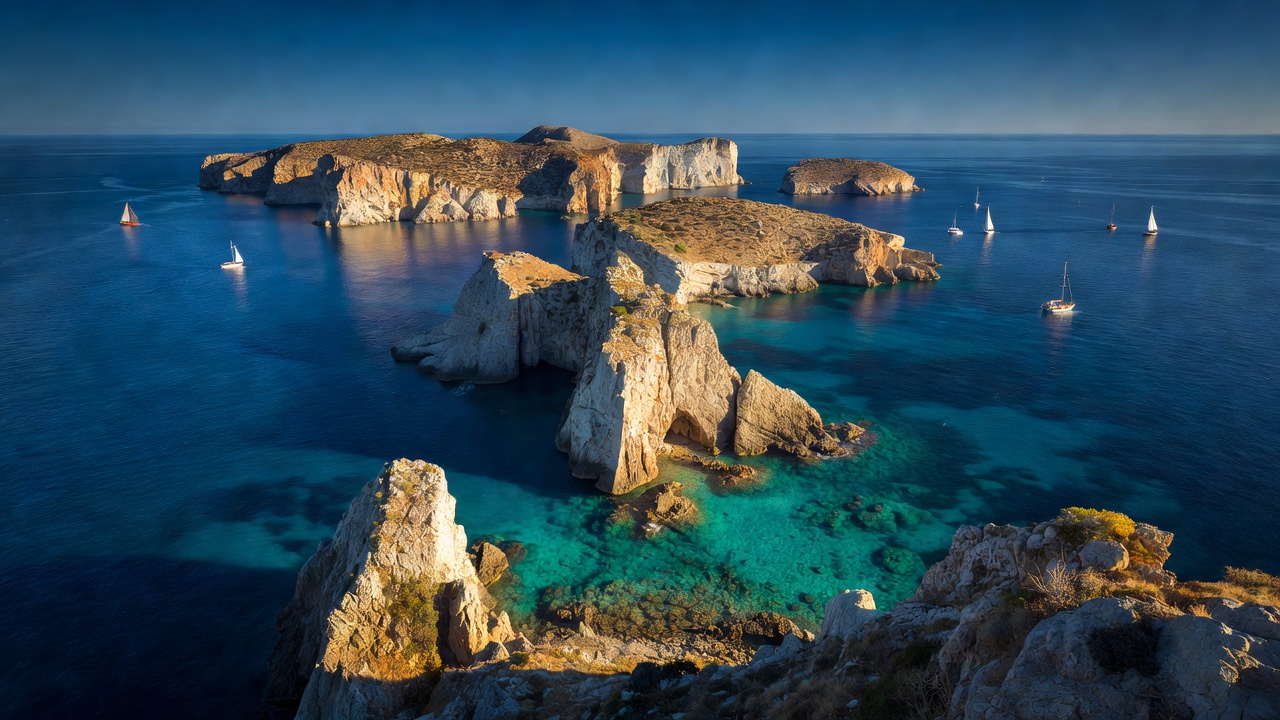
Just ten nautical miles south of the heavily trafficked southern coast of Mallorca lies the Cabrera Archipelago Maritime-Terrestrial National Park. Comprising 19 islands and islets, Cabrera represents one of the most successfully preserved marine environments in the western Mediterranean. The isolation that once made it a French prisoner-of-war camp in the 19th century and a military zone in the 20th century has inadvertently protected its ecosystems from the mass tourism boom that reshaped the rest of the Balearics.
Regulatory Framework and Permits
Navigating and mooring in Cabrera is subject to stringent regulations designed to protect the fragile benthic communities, particularly the endemic Posidonia meadows. Free anchoring is universally prohibited throughout the entire archipelago. Yachts wishing to stay overnight must secure one of the color-coded mooring buoys laid out in Puerto de Cabrera, the main natural harbor.
Securing a buoy requires applying for a navigation and mooring permit well in advance through the Balearic government's online portal. The buoys are restricted by vessel length (up to 35 meters max, with very few large buoys available) and are limited to a maximum stay of two nights in the summer season to ensure fair access. Rangers actively patrol the area; arriving without a pre-approved permit will result in immediate expulsion and potential fines.
Puerto de Cabrera
The main harbor is an exceptionally well-protected natural inlet, shielded from all wind directions except a strong northerly. Entering the bay, mariners are greeted by the striking silhouette of a 14th-century castle perched on a rocky outcrop, originally built to defend against Barbary pirates. The mooring field is well-maintained, with heavy-duty lines attached to ecologically friendly helical anchors screwed directly into the sandy seabed, bypassing the seagrass entirely.
Marine Life and Activities
Because commercial fishing is banned and recreational activities strictly controlled, the marine biodiversity here is staggering. Divers and snorkelers routinely encounter large groupers, barracudas, loggerhead turtles, and occasionally dolphins. The water clarity often exceeds 30 meters.
A must-visit site is the Cova Blava (Blue Cave) on the northern coast of the main island. Accessible only by tender or small craft late in the afternoon, the cave's orientation causes the sunlight to illuminate the water from below, creating an intense, glowing sapphire effect. Note that entering the cave with motorized vessels is restricted to low speeds, and anchoring outside it is forbidden; vessels must stand off while crew rotate into the tender.
Ashore and Logistics
Onshore facilities are Spartan, reflecting the park's conservation status. There is a small visitor center detailing the natural and human history of the islands, a basic canteen (cantina) offering drinks and simple meals, and a few designated hiking trails. Hiking outside these trails is strictly prohibited to protect nesting bird species like the Eleonora's falcon.
Pros and Cons
Advantages: Ultimate tranquility, complete absence of the jet-ski and super-club culture found in nearby Ibiza or Mallorca, and some of the best snorkeling and diving in Spain. The mooring buoys provide absolute security without the anxiety of dragging an anchor.
Disadvantages: Bureaucracy. The permit system requires rigid pre-planning, which clashes with the spontaneous nature of sailing. There are zero facilities for yachts—no water, no shore power, no fuel, and no garbage disposal (all waste must be taken back to Mallorca).